Systems Thinking for AI: Why Complex Organizations Need a Different Approach
Systems Thinking for AI: why complex organizations need a different approach to succeed with artificial intelligence — beyond tools and technology.
ARTIFICIAL INTELLIGENCE
Video Guru
6/27/20266 min read
AI promises transformation, but most big organizations deliver disappointment. They treat AI like any other IT project—define requirements, build or buy, deploy, done. Then reality bites. Pilots fizzle. Costs balloon. Teams resist. The system pushes back.
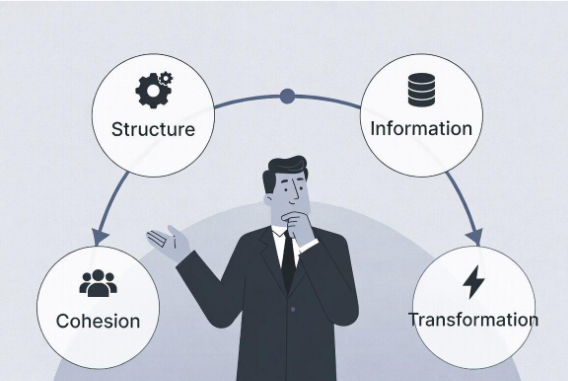
I’m Miklós Róth, founder of Roth AI Consulting. After years guiding mid-to-large organizations through AI initiatives, I’ve learned one core truth: linear project thinking fails with AI because AI interacts with complex adaptive systems. Your organization isn’t a machine with predictable inputs and outputs. It’s a living network of structures, information flows, relationships, and evolutionary pressures. That’s why I developed and apply the S•I•C•T framework—Structure, Information, Cohesion, Transformation. It offers a practical systems lens for AI success.
This isn’t academic theory. It’s battle-tested in real companies where traditional approaches wasted millions. Let’s explore why linear fails, what systems thinking for AI looks like, and how you can apply it.
Why Linear Project Thinking Crumbles with AI
Traditional project management assumes clear cause and effect. Step A leads to Step B. AI doesn’t work that way in complex organizations. It touches everything—processes, power dynamics, skills, culture, even external ecosystems.
Linear plans ignore feedback loops. Deploy an AI tool for customer service and suddenly agents need new skills, knowledge bases require constant updates, and customer expectations shift. Marketing wants to use generative AI, creating brand risks that legal never anticipated. Finance sees efficiency numbers but misses hidden technical debt.
These are emergent behaviors. AI amplifies existing patterns—good and bad. In a siloed organization, it creates more silos. In a high-trust environment, it accelerates collaboration. Linear thinking pretends these interconnections don’t exist or can be managed later. They can’t.
I’ve watched a large retailer roll out demand forecasting AI. Technically sound. Business case compelling. Result? Store managers ignored recommendations because incentives rewarded sales targets over inventory optimization. Structure—incentives and decision rights—clashed with the new tool. Information flowed poorly between central models and local realities. Cohesion between headquarters and field teams suffered. Transformation stalled.
Linear approaches also underestimate uncertainty. AI models evolve. Data drifts. Regulations change. Organizations that lock into rigid roadmaps fall behind fast. Systems thinking embraces iteration, sensing, and adaptation.
Introducing the S•I•C•T Framework for AI
S•I•C•T provides a diagnostic and design grammar for navigating complexity. Each dimension interacts dynamically. AI initiatives succeed when they strengthen the overall system rather than optimizing one part at the expense of others.
Structure refers to the formal and informal architecture: processes, roles, hierarchies, incentives, and resource allocation. With AI, ask: Does your structure support rapid learning cycles or enforce slow approval gates? Are budgets aligned to cross-functional outcomes or departmental silos?
Information covers how signals are generated, filtered, shared, and acted upon. AI generates massive new data streams. Strong systems design ensures high signal-to-noise ratio, feedback loops, and accessibility. Weak ones drown in hallucinations, bias, or overload.
Cohesion measures how well parts hold together—trust, shared mental models, collaboration norms, alignment of purpose. AI can unify or fragment. It surfaces tensions in values, priorities, and identity that were previously latent.
Transformation is the system’s capacity to evolve: learning speed, adaptability, resilience to shocks, and ability to reconfigure. AI demands high transformation capacity. Organizations with low capacity experience rejection—superficial adoption followed by reversion to old ways.
These four aren’t isolated pillars. They form an interdependent field. Change one and others shift. Successful AI leaders monitor and balance all four.
What a Systems Approach Looks Like in Practice
Systems thinking for AI starts with diagnosis, not solution shopping. In mid-to-large organizations, I typically begin with a cross-functional workshop mapping current state through S•I•C•T.
Example: A global manufacturing company wanted to implement predictive maintenance AI across dozens of plants. Linear plan: select vendor, install sensors, train models, roll out.
Systems diagnosis revealed issues. Structure: Maintenance teams had incentives based on reactive repairs, not prevention. Information: Plant data was inconsistent in format and quality; central insights rarely reached local engineers in actionable time. Cohesion: Headquarters was seen as out-of-touch with shop floor realities. Transformation: Past tech initiatives created cynicism—“another flavor of the month.”
Instead of forcing the rollout, we co-designed interventions. Adjusted incentives blended uptime and proactive work. Built information dashboards tailored to local contexts with feedback mechanisms. Ran cross-plant learning forums to build cohesion. Phased transformation with pilot sites that demonstrated value and trained internal champions.
Result: Higher adoption, sustained ROI, and organizational learning that benefited other initiatives. The AI project became a catalyst for broader evolution, not an isolated tech win.
In professional services firms, another common pattern emerges. Partners use generative AI for proposals and analysis. Linear thinking focuses on tool access and training. Systems view examines how this shifts leverage models, billing practices (Structure), knowledge sharing (Information), team dynamics between juniors and seniors (Cohesion), and the firm’s overall service delivery evolution (Transformation). Addressing these holistically prevents unintended deskilling or quality erosion.
Practical Steps for Implementing Systems Thinking
You don’t need to overhaul everything at once. Start where AI intersects your biggest opportunities or pain points.
Map the System: Use S•I•C•T to create a shared visual of current reality. Involve diverse voices—executives, middle management, frontline. This builds cohesion from day one.
Identify Leverage Points: Look for places where small changes yield big systemic effects. Often, improving information flows or realigning incentives delivers outsized impact.
Design Feedback-Rich Interventions: Every AI pilot should include explicit learning loops. What’s working? What’s emerging? How are the four dimensions shifting? Adjust weekly or monthly, not quarterly.
Build Distributed Capacity: Transformation isn’t top-down only. Develop AI fluency at multiple levels. Create communities of practice that span departments to strengthen cohesion.
Monitor Systemic Health: Track leading indicators across S•I•C•T, not just project KPIs. Are decision cycles speeding up? Is information quality improving? Is trust rising or falling? Are people adapting creatively?
For a large financial institution client, we applied this to fraud detection and customer personalization. Instead of separate projects, we treated them as interconnected. Better information sharing between teams improved both. Structural changes in risk committees enhanced governance cohesion. The organization’s transformation capacity grew, enabling faster future initiatives.
Mid-sized companies benefit too. A 500-employee logistics firm used S•I•C•T to guide route optimization AI. They discovered that driver autonomy (Structure) was key to acceptance. Real-time information sharing via mobile apps boosted cohesion between planners and drivers. The result was safer, more efficient operations and higher employee satisfaction.
Common Pitfalls and How Systems Thinking Avoids Them
Linear thinkers often over-focus on technology and under-invest in adoption. Systems thinkers balance both. They anticipate second- and third-order effects.
They avoid the “pilot purgatory” where dozens of experiments run without integration. By viewing AI portfolio through S•I•C•T, priorities become clearer—invest in areas that reinforce overall system health.
They don’t treat resistance as an HR problem. Resistance signals misfit between the intervention and the system. Diagnose through the framework and redesign accordingly.
In complex organizations, AI success is less about brilliant models and more about coherent integration. Systems thinking makes that possible.
The Leadership Mindset Shift
Adopting this approach requires humility and curiosity. Leaders must move from “implement this solution” to “how does this evolve our system?” It’s more demanding but far more rewarding.
As CEO or executive, model systems thinking. Ask S•I•C•T questions in strategy meetings. Celebrate learning as much as winning. Invest in capabilities that endure beyond any single tool.
The organizations thriving with AI in 2026 aren’t necessarily the biggest or richest in tech. They’re the ones that treat AI as a systemic catalyst rather than a project list item. They build resilience, adaptability, and intelligence into the organizational fabric itself.
If your company feels the tension between AI ambition and execution reality, it’s time for a different approach. Linear worked for yesterday’s systems. Complex adaptive organizations need systems thinking.
Explore these ideas further and access diagnostic tools at rothaiconsulting.com. Let’s apply S•I•C•T to your unique context and unlock AI’s true potential.
(Word count: approx. 1990)
FAQ
1. What is systems thinking for AI? It’s an approach that views AI not as isolated technology but as an intervention into a complex organizational system, focusing on interconnections and emergent outcomes rather than linear cause-effect.
2. Why does the S•I•C•T framework matter for business AI transformation? It provides a practical diagnostic for Structure, Information, Cohesion, and Transformation—revealing why many technically sound AI projects fail to deliver systemic value.
3. How is systems thinking different from traditional project management? Traditional methods emphasize plans, milestones, and deliverables. Systems thinking emphasizes feedback, adaptation, leverage points, and overall health across interdependent dimensions.
4. Can mid-sized companies apply this without huge consulting budgets? Yes. Start with internal workshops using S•I•C•T, targeted pilots with learning loops, and gradual capability building. Fractional expertise can accelerate the process cost-effectively.
5. What are signs that linear thinking is failing our AI efforts? Low adoption despite good tech, unintended side effects, repeated pilot failures, or enthusiasm fading after initial launches. These indicate ignored systemic interactions.
6. How do I start using S•I•C•T in my organization? Map your current state across the four dimensions for a key AI opportunity. Identify imbalances and design balanced interventions. Repeat iteratively.
7. Does systems thinking slow down AI deployment? Initially it may feel slower due to deeper diagnosis, but it dramatically increases success rates and sustainable value, avoiding costly rework.
8. What role does leadership play in a systems approach? Leaders set the tone for curiosity, model systems questions, ensure cross-dimensional visibility, and champion learning over rigid adherence to plans.
9. How does this apply to generative AI specifically? Generative tools amplify information flows and creativity. Systems thinking ensures they enhance cohesion and transformation rather than creating noise, fragmentation, or overload.
10. Where can I learn more about applying S•I•C•T to AI? Visit rothaiconsulting.com for articles, case studies, and practical resources grounded in real organizational experience. The framework scales from individual initiatives to enterprise strategy.